
Join us here for the ongoing tails of the Artisans and Entrepreneurs of Utah's Heritage Highway 89. This is part of an occasional series by the Utah Heritage Highway 89 Alliance that highlights people and places along Utah's Heritage Highway, US. Highway 89.
Big Rock Candy Mountain 'Buzzin' of the bee's in the peppermint trees.
Ron Bushman Family history woven into the works of local rug maker.
Clayton Cox Long, cold Utah winter helps furniture maker find his niche.
Country Cousins 'Corner Store' Grows into thriving business.
Larry Nielson Wood is a canvas for Ephraim Artist.
Buster Warenski Knife-maker makes knives because painting was not fun!
Karen Crosby Local Quilter going crazy for her craft.
Sallee Kessler Monroe Jewelry Maker has International Flare.
Paul Hart Music Maker opens shop in Mt. Pleasant.
Sil Hathaway Home is where the kitchen is.
Steve Johnson Knife making is lifelong calling for Manti craftsman.
Linda Leavitt Running a craft store is a family affair.
Winnie Wood Wine making labor of love, inspiration for local artist.
Big Rock
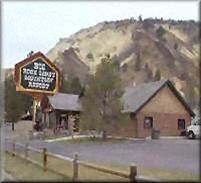
BUZZIN' OF THE BEES, PEPPERMINT TREES AT BIG ROCK CANDY MOUNTAIN Editor's Note: This is part of an occasional series by the Utah Heritage Highway 89 Alliance that highlights people and places along Utah's Heritage Highway, US. Highway 89.Like many other Utahans, Angela Keele remembers learning a childhood song about a place where bees buzz in peppermint trees, the bluebird sings, and there are lemonade springs and soda water fountains.
She just never imagined that one day, she would grow up to be the general manager of Big Rock Candy Mountain, located in Marysvale about 20 minutes south of Richfield on U.S. Highway 89. "1 remember coming through here as a child on summer vacation. I loved it then, so when I got the chance to come down here and take this job, it was like a dream come true. I always wanted to live in a small town and here I am." Keele has managed the Big Rock Candy Mountain resort for the past for years. She moved to Marysvale in 1996 to oversee the renovation and restoration of the facility, which includes an inn, camp ground, conference center and restaurant. "It was named Big Rock Candy Mountain because of its caramel-colored rock formations," Keele says. "It looks just like a huge chocolate and caramel sundae."
The mountain and resort was made famous when actor Burl Ives recorded the song by folklorist Harry McClintock, and it still holds its magical appeal for Keele and the more than 2,500 people who visit each year. "The song was originally written by McClintock who was a brakeman on the Rio Grande Railroad that used to run behind the mountain," Keele says. 'The folklore says that the hobos used to ride the rails and get off here because the people here would feed them and let them stay here, and it was just a nice place. They sang about the lemonade springs and the bluebird singing because it was so peaceful."
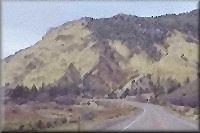
The Big Rock Candy Mountain Resort includes river side cabins with indoor plumbing (some of which have kitchenettes), a country inn, the Big Rock Cafe, a gift store and candy store that, among other things, sells rock candy" that resembles pebbles and crystals. The resort also offers a two-hour, six-mile river raft ride down the Sevier River, tent camping area with fire pits are barbecues, RV parking, fishing, swimming, hiking, bicycling, horseback riding, kayaking, windsurfing, sightseeing tours and access to ATV trails.
The facility opens each year on Easter, kicking off the season with a big Easter Egg hunt, and remains open until Dec. 1. For more information on Big Rock Candy Mountain, call 1-888-560-ROCK.
For more information contact:
Big Rock Candy Mountain
4479 North Highway 89
Marysvale, UT 84750
1-888-560-ROCK
Ron Bushman
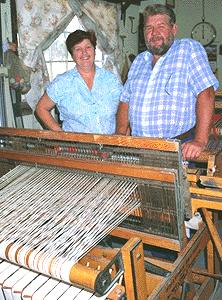
Family history woven into the works of local rug maker. Editor's Note: This is part of an occasional series by the Utah Heritage Highway 89 Alliance that highlights people and places along Utah's Heritage Highway, US. Highway 89.
Ron Bushman has been weaving rugs for as long as he can remember. "My earliest memories are of standing on a box to reach the beater, the name for the handle on the loom. I was probably five or six years old."
His grandfather, Charles Christensen, was a renowned weaver who immigrated from Denmark in 1994 and ran rug-making shops near Bryce Canyon and later Marysvale. Christensen had seven children, but he taught his trade to only one of his children: his oldest child, Ester, Ron Bushman's mother.
"When I was growing up, weaving rugs was simply part of the chores". I used to say "my mother learned to weave from my grandfather, and then she made me do it" "I remember how much I hated doing the rag preparation part, it took such a long time."
But perhaps Ester Bushman recognized the importance of family tradition. Perhaps she figured making rug-weaving a "chore" was the best way to teach her children the skill and ensure that their grandfather's legacy continued. Whatever her motives and methods, Ester Bushman did something right. After years of working as an electrician and a Utah Highway Patrol Officer, Ron Bushman now makes his living weaving rugs, and he does it from the very shop from which his grandfather made his creations in Marysvale. The store is named "Lizzie and Charlie's Rag Rugs" after his grandparents. Charles and Elizabeth Christensen.
Here is something else that would make Lizzie and Charlie - and Ester - proud: Their grandson and son was recently recognized by the Utah Arts Council for his rug-weaving, receiving a Special Citation Award for Contributions to the Arts. He was also recognized for his affiliation with the Festival of the American West and his membership on the U.S. 89 Heritage Highway Alliance.
Bushman's rugs are shipped all over the world, to places as far away as Denmark Sweden and Alaska and they range in size from "place mat" style to "room-size." "We've made some rugs that are 15-feet by 45-feet," Bushman says. And each and every rug is made according to the old-fashioned, Bushman-family tradition: the long and hard way. "It is very labor intensive. It takes 12 yards of fabric to do one yard of a rag rug," Bushman says. The fabric must be cut into strips and sewn together before it is woven on the loom. "You have to be very precise to make sure you get the same color configuration throughout the rug."
How Bushman came back to embrace his once-detested "chore" and make it his livelihood, and how he ended up back in his grandfather's shop, is quite a story. "My wife Glenda and I got married in 1959 and we were working in Salt Lake City making peanuts. So we bought a loom and just started weaving, sort of on the side. Then in 1968, we bought the store my mother was running in Marysvale. Around 1990, 1 decided to restore my grandfather's old shop."
It was not an easy decision.
The building - once a JC Penney store- had amazing family history. It had been abandoned by the department store in 1918 and purchased by Charles Christensen in 1928. He eventually restored the building and wove rugs out of it for nearly 20 years. But the shop had sat empty since about 1947. "It slowly became a general storage area for everyone in the family," Bushman says. "Around 1990, it became so dilapidated that our only options were fixing it up, or burning it down. I toyed more than once with the idea of burning it down. but I didn't" he says.
Once again, Charlie, Lizzie and Ester would be proud.
For more information contact:
Lizzie and Charlie's Rag Rugs - A Working Museum
210 East Bullion Avenue
Marysvale, UT 84750
435-326-4213 (phone)
Clayton Cox
Long, cold Utah winter helps furniture maker find his niche.Editor's Note: This is part of an occasional series by the Utah Heritage Highway 89 Alliance that highlights people and places along Utah's Heritage Highway, US. Highway 89.Clayton Cox has a long and cold Utah winter to thank for helping him get into the rustic
furniture-making business.
Some years ago, Cox, of Duck Creek near Panguitch. was running a gas station on U.S. 89. "Business was very slow that winter," be says. So to make extra income, he took in work peeling logs" for a private company, stripping them of their bark until they were long and smooth poles. "I got paid by the foot, and it turned out they gave me more logs to work on then they needed. They paid me anyway, but let me keep the extra logs. So in my spare time, I decided to start building furniture out of them.
"So I built a few pieces, just for fun as a hobby, and they sold." So Cox kept on making furniture in his spare time for several years, and four years ago, he decided to make it his fulltime profession. He opened Rustic Mountain Furniture in Duck Creek where he and two fulltime employees now craft a couple of hundred furniture pieces annually, along with manufacturing about 5,000-feet of log railing. Their customers come from as close as Duck Creek to as far away as Alaska, and are a mix of private home owners and retail businesses, such as lodges. "It started with local customers mostly, and then people started hearing about us word-of-mouth." He recently completed a huge project at the new Zion Mountain lodge. "We furnished the entire thing."
"We can make anything: beds, a chest, sofas, dining room sets, cabinets, armoires" Cox says. He harvests much of the wood he uses himself - namely aspen from Cedar and Beaver Mountains, adding that they only use "dead logs" and do not remove any live trees. He also gets some wood from Montana.
Cox is in the process of moving his shop to the nearby town of Motorville. He will go from a 4,500-square foot workshop to a 17,000-square-foot shop located right on U.S. Highway 89. He is working on developing a web page to showcase his creations along with a catalogue.
What are his favorite pieces to make? I would say working with aspen. Every piece is different, every pieces speaks for itself and takes on its own personality.
"Plus, we harvest the aspen here, and there is nothing like going out and harvesting a tree yourself and then creating something out of it. There is nothing like that"
For more information contact:
Monte Bona
(435) 462-2502
Country Cousins
CORNER STORE' GROWS INTO THRIVING BUSINESS Editor's Note: This is part of an occasional series by the Utah Heritage Highway 89 Alliance that highlights people and places along Utah's Heritage Highway, US. Highway 89.Country Cousins, a craft/quilt store located at 27 North Main Street in Manti, got its start in the corner of an upholstery store.
During the annual Mormon Miracle Pageant, Erma Young, Norma Prestwich, Dawna Vee Bown, Brenda Bailey and others would bring their hand-made wares to an upholstery shop owned by Young's husband. They'd clear out a corner and set up a temporary quilt/craft store, selling items to people in town for the big show.
After a couple of years, the women decided to leave their crafts in the "corner store" year round. Various craft makers would bring in items throughout tile year, and Young's husband would sell them from his upholstery shop.
"It ended up being so much fun, we decided to stay," Young says. The corner store grew into what is now Country Cousins, which officially opened in its own location in 1987. The store sells hundreds of handmade items, ranging from quilts, blankets, dolls and stuffed critters to woodworking and crocheted items.
At one time, as many as 15 women who had part ownership in the store. Many went on to open their own businesses. Country Cousins is now owned and run by Young, Prestwich, Bailey and Bown. There are more than 60 consignors.
The four owners come from the comers of Sanpete County. Young is from Stirling, Prestwich from Moroni, Bown from Manti and Bailey from Fountain Green. Each woman also specializes in one or two crafts which are sold in the store. Young is the quilter, creating beautiful quilts which are displayed and sold in the store. Prestwich makes dolls and stuffed critters, Bailey sews hand-made dish bags and aprons and is the shop's book keeper, and Bown does crochet items and wood working.
Country Cousins is open from 10 a.m. to 6 p.m. Monday through Saturday. The exception is during the Mormon Miracle Pageant, when the store is open from 9 a.m. to 9 p.m. The pageant that helped make the comer store a thriving business still warrants the extra hours. "People come and go, they drop in for 12 hours a day," Prestwich says.
For more information contact:
Country Cousins Gift Shop
27 North Main Street
Manti, UT 84642
435-835-4438 (phone)
Larry Nielson
WOOD IS A CANVAS FOR EPHRAIM ARTISTEditor's Note: This is part of an occasional series by the Utah Heritage Highway 89 Alliance that highlights people and places along Utah's Heritage Highway, US. Highway 89.Larry Nielson may be one of the only artists around who waits for his canvas to "speak to him" before he picking up a paintbrush.
"The wood tells me what to do with it, it is like it has its own spirit," says Nielsen, an Ephraim artist who has become known for his paintings on old and weathered wood. "Every piece of wood is a challenge, a different experience. Sometimes, I see a piece of wood and there is an immediate connection, I know just what it wants me to do with it. Other times, I have to put a piece away for a while, then bring it back out later and I will see something special in it, a face or something, that needs to come out. It is very personal."
A longtime artist and performer, Nielson started using wood as his preferred canvas about four years ago. "I've always painted, and one day, I just decided to try using wood and that was it. I'm become obsessed with it, I think about it day and night, what I can do. I have such a reverence for wood and what it means to us visually."
Now, Nielson finds his canvasses anywhere and everywhere, in fields and in ditches, on old houses and barns. "Sometimes the wood is really weathered and old and even has rusty nails, and often, I just keep the nails in there and use them in my work. Every piece is different." Word has even gotten out around town. "People will call me and say that they have an old barn door or a shed and I can have the wood. It is great that people are helping out," he says.

Nielson mainly concentrates on painting portraits-of Native Americans, wildlife, rodeo scenes and Western themes such as rodeos and cowboys, using mostly acrylic paints. "I rarely use new wood, I find it too smooth and too boring." However, he has recently begun experimenting with a new wood from Bolivia that has an interesting texture and surface. He works mostly from a studio in the garage behind his family home on Main Street in Ephraim, calling it Wind and Wings Wood Works (Wind and Wings). The Victorian home from which he is based has been in his family for more than 100 years. "It is on both the state and national historic register," Nielson says. "My grandfather is from Ephraim, I went to school here, this is my family, this is my home."
Neilson spent time in Los Angles working as an artist and back-up singer, and in Hawaii working for the Polynesian Cultural Center. During his time away, always made it a point to get back home regularly. "I've always loved Sanpete County, and I have found myself spending more and more time here. I've finally decided if I'm going to keep painting on wood, I need to come back here because I'm not going to find much wood in Los Angeles. So now, I'm in the process of moving back permanently. Sanpete County is just so peaceful, and my family history is here," he says adding that his mother, Virginia, is a well-known historian.
Most recently, Nielson has shown his work in Park City, Kamas, St. George and at Thanksgiving Point in American Fork. He will also have a show in Orem Nov. 27 2001. And as always, the size, shape and theme of his art is dictated by the wood on which he is working. "I just finished a painting that is 58 inches long, it is of a herd of wild horses and the impressions in the wood make it look like they are running through the sage brush."
For more information contact:
Larry Nielsen
Wind and Wings Wood Works
Ephraim, UT 84627
Wind and Wings
PO Box 8169
Midvale, Utah 84047
801-568-9792 (phone)
801-566-7779 (fax)
Email: custserv@windandwings.com
Buster_Warenski
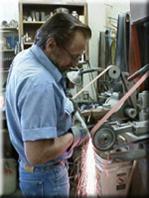
Knife-maker makes knives because painting was not fun!Editor's Note: This is part of an occasional series by the Utah Heritage Highway 89 Alliance that highlights people and places along Utah's Heritage Highway, US. Highway 89.Ask Richfield resident Buster Warenski why he gave up life as a painter to become a knife-maker and he will give you a straight and simple answer: "making knives is fun and painting wasn't."
"I was always making knives on the side when I could when I was working as a painting contractor," he says. "It was just a hobby that sort of got out of hand."
Out of hand is one way to put it. Warenski's knives are in such demand that his waiting list has been known to exceed 10 years and he charges between $3,000 to $ 10,000 per knife and has clients all over the world. "The Japanese market is very good, we sell to collectors her in the U.&, the European market, Canada, Australia, France, England, Italy," he says.
Not bad for a "hobby that got out of hand." Warenski opened his business, Warenski Custom Knives, out of his home in 1973. "It took a year to see if I would have enough work to make it full time, and by 1974, 1 had more than enough. We advertised a little bit in the beginning, but I haven't advertised in about 20 years because I have such a backlog. I still take custom orders, but it is always with the understanding that I will do it when I have the time."
Warenski, who started his "hobby" in the mid 1960s, says he can make "any kind of knife that a person can dream up, or I can dream up, or any picture someone can scrounge up," he said. "I do mostly artsy stuff, rather than hunting or utility knives. And I've made three knives that were solid gold: the blades, the handles and sheaths, everything was gold. One of them sold in the six-figures."
He makes knives mostly for collectors who know exactly what they want and how much that kind of high-quality product costs. "I would say there are 300 to 400 knifemakers like myself in the country who have massive collections of knives." Warenski can only make about 25 knives a year, with each knife taking between two weeks and several months to craft, depending on the design. "I always start by drawing a picture of the knife: the shape, the blade, the handle. I spend a lot of time with pencil and paper trying to come up with something new." He then moves to his shop, where he will "lay out" the knife place on a piece of steel and grind it to shape, working later with heat and a special polishing technique. He crafts his handles from a variety of materials, including stone, jade, marble and other exotic stone. "My wife, Julie, does all of the engraving for my knives, and she does engraving for other knife makers as well," Warenski says.
Warenski still operates out of his home in Richfield, where he has lived nearly all his life. He recently added a web page, www.warenskiknives.com. "It only been running about two months, but we are getting upwards of 600 hits a day, which is quite good."
For more information contact:
Buster Warenski
Box 214
Richfield, UT 84701
435-896-5319 (phone)
435-896-8333 (fax)
Email: buster@warenskiknives.com
Web: Warenski Knives
or
Monte Bona
(435) 462-2502
Karen_Crosby
LOCAL QUILTER GOING CRAZY FOR HER CRAFTEditor's Note: This is part of an occasional series by the Utah Heritage Highway 89 Alliance that highlights people and places along Utah's Heritage Highway, US. Highway 89.In a roundabout way, Karen Crosby has her children's interest in sports to thank for helping her become a maker of "crazy quilts."
"My kids are very busy playing ball and other sports, and I'm waiting around a lot for them to finish practice or a game," says Crosby, a resident of the town of Alton, near Panguitch and Kanab. "But I don't like to just sit, so I started taking embroidery along with me in my purse and I'd work on things while I was waiting."
That little past time has flourished into a hobby that keeps Crosby occupied both on and off the "playing field." She has become well-known as a maker of "crazy quilts," the name for intricate embroidered work that is created on blocks of material and then used as pillow tops, throws, wall hangings and sometimes even applied to blankets.
"It was a craft that developed in the 1800s, and it involves small, intricate stitches. It isn't what most people envision when they think about quilts," Crosby says. "It is definitely not something that can be used to make a patchwork quilt, the sections are too heavy. It is more like a work of art rather than pieces for a quilt."
Crosby does mostly custom and special orders, working from her Alton home. "It takes a long, long time to do one project. For example, a square that is I I inches by 12 inches would take about 40 hours." She faithfully follows the traditions created by the crazy quilters of the 1800s, meaning that the work is small and intricate, and done entirely freehand. I have about 100 different stitches, and I do the embroidery work at random, there is no set pattern. I create a basic design and then do fancy things like stars, hearts or little animals. No two pieces are exactly alike. I do things out of impulse usually."
Crosby, who also runs a Victorian doll company, has a reputation around town for being a craft maker. She added crazy quilting her repertoire about five years ago. I have embroidered by entire life, but it was always only a hobby until people started telling me I should sell some of my work. I attended a demonstration once on crazy quilts and just fell in love with it. So I bought some books and that was how it all began."
For more information contact:
Monte Bona
(435) 462-2502
Sallee Kessler
Monroe Jewelry Maker has International Flare.Editor's Note: This is part of an occasional series by the Utah Heritage Highway 89 Alliance that highlights people and places along Utah's Heritage Highway, US. Highway 89.From the basement of her home in the tiny town of Monroe, Utah, Sallee Kesler offers her customers the world.
Kesler is a self-taught maker of fine jewelry. And the materials she uses to design her custom-made, one-of-a-kind pieces -- coral, jade, gold, and silver, to name a few -- come from places like Bali, Indonesia, Thailand, Africa and Hong Kong.
"I also use a lot of materials that are made by other people, like hand-carved gemstones. I even found one man in Tahoe who does fossil carvings in Ivory and I incorporate his work into my pieces," she says. "I have made pendants from pieces of pottery, from materials left over from the Ming Dynasty, from African beads that are 200 to 300 years old, and I even have some beads from Persia that are 400 years old that I am mixing into some pieces. I always look for the unusual. I check out all of the antique stores that I see and I hit the estate sales." But finding those unusual items -- and enough of them -- to use in her designs requires a lot of patience. "Once I found a few Russian bears made of beautiful stones, but I didn’t have enough to do anything with them. It took me three years before I finally accumulated eight of them, enough to do a necklace and some earrings. Another time, I wanted to do something from some beads from Bali that had inlaid carvings, and it took me four years to accumulate enough to do a necklace. I ended up bartering that necklace away for marble tile for floors in my house, but now I have really beautiful marble tile," she says with a laugh. "I do a lot of bartering in this business."
Kesler says that she has always been interested in jewelry design. "I’ve been making jewelry since junior high school." But she started her career as an artist designing quilt patterns and making quilts and dolls. She switched back to jewelry when quilt-making became a big import-business. "Nowadays, you can go into a discount store and buy a quilt made in China for $50, and I can’t even get the material for that," she says. "So I gave decided to make jewelry again and started experimenting."
Kesler gets some assistance from her husband, Vaughn. "He is better than I am at wrapping wires and working with clasps because his hands are stronger than mine. He was an electrician in the military, so he knows how to do a lot of things to help me, like tie knots so things don’t fall off," she says with a laugh.
Currently, Kesler shows her jewelry at her home by appointment only, and attends a few special jewelry shows a year throughout the Southwestern United States. "Most people who come to me have heard of what I do and have something special in mind. They may have a necklace from their granny they want modernized, or are looking for a special piece."
"I love having customers come by to see what I do, and I love designing for people and I love making jewelry." Kesler’s future plans include developing a web page to help her market her jewelry to a wider audience. "I would like to sell more of my jewelry and be free to continue living in rural Utah, enjoying the beauty of this wonderful place."
For more information contact:
Sallee Kesler
285 S 100 West
Monroe, UT 84754
(435) 527-1880 (phone)
email: jade28585@msn.com
Paul Hart
Music Maker opens shop in Mt. PleasantEditor's Note: This is part of an occasional series by the Utah Heritage Highway 89 Alliance that highlights people and places along Utah's Heritage Highway, US. Highway 89.A new kind of craft-making business has come to town.
In a historic building on Mt. Pleasant's Main Street that once housed the Vintage Rose craft store, Paul Hart is making music. Hart, a recent Salt Lake City transplant, is teaching a handful of students the painstaking fine art of violin making,. He and his students -- who come from as far away as Iowa and Alaska are making violins, violas, basses and cellos in a I 100year-old building, located at 3 6 W. Main Street.
Hart has been constructing instruments since fie was a teenager. He comes from a musical family, and was interested in taking up the cello as a youth. "I also liked to work with my hands, so I thought I would try to make a cello so I wouldn't have to buy ore," he says. "I ended up selling it." That -vvas the first time I realized I could do something I enjoyed,. work with my hands, and make some money too."
Hart worked in Salt Lake City, making violins and teaching, since 1969. He also spent time in Mexico in the 1980s, making violins at a special art school set up by the wife of the country's president. In recent years, he concentrated on making violins rather than teaching the craft. But he kept getting requests from people looking for training, "There are not many good places to learn the craft," he says, "I started thinking 'if I could find the space.. I could take on some students."
Hart moved to Mt. Pleasant a little over a month ago, and currently has three students. He plans to increase his class size to about a half-dozen. "I didn't advertise, word just kind of got out," he says. It takes about four years to become a violin-maker. The students plan to live in the community while they complete their training. Hart currently lives in an apartment above the violinmaking school, but is looking to buy a home to convert into a dormitory for students.
"I wanted to be a rural community, and be close to my father, who lives in Provo," Hart says of his move to Sanpete County. "I wanted to I ive somewhere rustic, where it was quiet, and I could run and hike."
For now, his new craft-making business is nameless. 'I'm searching for a name. I'm kind of stumped at the moment."
For more information contact:
Paul Hart-Violin Maker
36 West Main
Mt. Pleasant, UT 84647
435-462-0301 (phone)
Sil Hathaway
HOME IS WHERE THE KITCHEN IS FOR SIL HATHAWAYEditor's Note: This is part of an occasional series by the Utah Heritage Highway 89 Alliance that highlights people and places along Utah's Heritage Highway, US. Highway 89.Sil Hathaway is always in the kitchen.
He started out there when he was 12 years old, washing dishes in Don's Cafe in Payson. He washed dishes, cooked and cleaned in many kitchens during his lucrative career in the restaurant business that included owning 17 restaurants in Utah County.
Now, Hathaway plans to spend the remainder of his career where he began it: in the kitchen, cooking for his customers. His final resting is the Horseshoe Mountain Restaurant in Mt. Pleasant, at 850 South and Highway 89.
"I've always been the chef in the kitchen, I've cooked in all my restaurants. If you've got a problem, it stops at my door. I am the kind of guy who loves to serve people, It is what I've done all my life," he says.
Hathaway acquired the Horseshoe Mountain Restaurant three months ago. He changed the menu to make it more family oriented, and is adding a feature that will highlight recipes of families in the community. "If people have recipes that are special to their families, that were handed down, we will run it as a special in the restaurant. I like to get the community involved in my restaurants," Hathaway says. People who have recipes they would like featured should contact the Sanpete Hathaway says he was still in his teens when he realized the restaurant business was to be his calling. One day while washing dishes in Don's Cafe, he was left in charge for an hour while the owner was away. "We got really busy. I was about 13 years old at the time, and it was the worst day of my life. I realized if I could handle that, I could handle anything," Hathaway says. "This is where I've been ever since."
Hathaway's wife, Wanda, has been part of that vision for many years. The two met while she was working as a waitress in a seafood restaurant in Provo where Hathaway was a cook. The owner eventually leased the restaurant to Hathaway. "Almost immediately afterward, a truck hit the sign outside the restaurant, so I put up a new one, and changed the name to Sil's Seafood Grotto." It was to be the first in a string of restaurants in Provo run by Hathaway, including. Magleby's and SiI's Ivy Tower.
But Hathaway grew tired of the ever-expanding Provo, and decided to move to the small town comfort of Sanpete County. He took over the Horseshoe Mountain Restaurant, and he and Wanda are building a home in Mt. Pleasant. Hathaway immediately established himself in the kitchen. "I want people to know that if they come to the restaurant, they should come to the back and say 'hi' to Sil. Sil is always in the kitchen."
For more information contact:
Horseshoe Mountain Restaurant
850 S. Highway 89
Mt. Pleasant, UT 84764
435-462-9330 (phone)
Steve Johnson
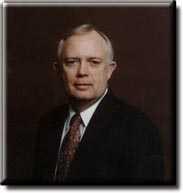
KNIFE-MAKING LIFELONG CALLING FOR MANTI CRAFTSMANEditor's Note: This is part of an occasional series by the Utah Heritage Highway 89 Alliance that highlights people and places along Utah's Heritage Highway, US. Highway 89.Steve Johnson was destined to be a knife-maker.
He was introduced to the trade that was to be Ills life's profession as a teenager on a Boy Scout outing. His scouting advisor, Gil Hibben, was a knife-maker and he took Johnson and a group of other scouts to Ills shop In Manti At the time Hibben was selling some knives for about $ 35 a price Johnson considered astronomical.
"I thought people must be crazy to pay that for a knife.' Then I saw them and I spent the entire next day figuring out how I would get $35 because I just had to have one of those knives."
Now, 33 years later, Johnson is making and selling, knives in his native Manti for prices far above what his mentor was asking back In the mid-1960s. Johnson's work is in such demand worldwide that there is a four-year backlog of orders. "I don't even promise delivery for about five years," he says with a laugh.
There was a time when Johnson considered doing something else with his life. He thought of being a teacher, earning a bachelor's of science degree from Brigham Young University in elementary education and even marrying a teacher.
But he never taught school on a full-time basis. By the time he graduated, there was a long list of people waiting for his custom, handmade knives. "While I was in school, I kept getting letters from collectors saying if I ever made knives again, would I make them one. By the time I finished school, I had enough letters for at least a year's work, so I thought I would try it for a year."
That year turned into decades. Johnson returned to his childhood home, opened a knife-making shop, and went to work. From that point on, he has been too busy to enter a classroom (save for a few stints as a substitute teacher). In fact, his wife Dorothy, a former teacher, never went back to the classroom either, staying home to raise their seven children and help him run his business.
Johnson's knife-making business is truly a family affair. Dorothy does the accounting and bookkeeping, and two eldest sons Rob and Nate helped out, sawing blades and doing some rough grinding, before going on LDS missions. His two younger sons, Mark and Mike and daughters Christine, Karen and Jennifer help out doing small, odd jobs around the shop.
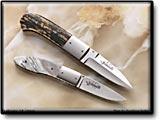
Johnson's makes about 85 to 90 knives a year and is known in the knife-making industry for fit, finish, polish and detail. His knives -- usually full tang hunters, boot and fighting knives -- range in price from about $450 to $5,000, depending on the style, make and type of handle.
Each knife is custom-made of special steel from Japan, and can take hours or weeks to create. Handles are made from Micarta (a type of plastic), exotic woods from South America, Africa and Mexico, pearl, stag horn imported from India and even animals tusks. "I've used mammoth ivory from prehistoric tusks found in Alaska and Siberia that have been preserved for who knows how many years," Johnson says. Johnson's customers come from all over the world. He has made knives for customers in Italy, Japan, France, Germany, Switzerland, England and even Tel Aviv. "I remember getting a call from the guy in the special forces of the Army in Tel Aviv, saying he needed a knife -- fast. I made it and sent it off. I don't know what ever became of it," he says.
"Ninety-five percent of the knives I make go into collections or are resold for collections."
Johnson learned the knife-making trade while in high school. After visiting Hibben's shop, he was invited to make a knife as a Boy Scout project Hibben recognized his potential and hired him part time. Johnson continued working for Hibben and fellow knife-maker Harvey Draper while attending Snow College. But before he finished school, he was lured away by an offer to make knives in Spokane, Washington. "Like so many students, I didn't know where I was going, or what I was going to do, so I dropped out even though I was almost done with school and took off for Spokane."
He ended up staying a year, going from there to Lawndale and Riverside California, working with tradesman Bob Loveless. Knives made with the "Loveless-Johnson"' trademark are now highly prized by collectors.
In 1974, Johnson was returning home to Utah for the annual deer hunt when he was hit by a drunk driver in Nevada. He suffered a broken pelvis and broken ribs, and spent weeks recovering in a hospital. "I was wearing a seat belt, it saved my life," Johnson said. "I decided I might as well finish my schooling, since I was back in Utah." After finishing up at Snow, he enrolled at BYU, and met his wife.
The rest is history -- or destiny.
For more information contact:
S.R. Johnson-Knife maker
202 East 200 North, Manti Utah 84642
Mail: P.O. Box 5, 84642
(435) 835-7941
Email: srj@manti.com
Web: SRJ Knives
or
Monte Bone
(435) 462-2502
Linda Leavitt
Running a craft store is a family affair. Editor's Note: This is part of an occasional series by the Utah Heritage Highway 89 Alliance that highlights people and places along Utah's Heritage Highway, US. Highway 89.Linda Leavitt and her daughter. Susan, 18, make many of the items offered for sale in Countryside Crafts, located at 152 West Main Street in Mt. Pleasant. They also staff the store, and handle the bookkeeping and other aspects of the business. Linda's mother, Lucie Swensen also works in the store a few hours a week so that her daughter and granddaughter can work on their crafts.
Leavitt does tole painting, while Susan does painting and some quilting The store also sells other handmade items supplied by local crafters and stocks painting and craft supplies. Leavitt relies on local wood cutters to supply many of the items she and her daughter paint.
Countryside Crafts also includes a gift store, and is in the process of opening a section for fabrics and sewing supplies. Leavitt recently bought out the shop "Sew and Save"' after its owner retired. The fabric and sewing section will be housed in a second side of the building.
All of it is still new to Leavitt, who opened her craft store only one year ago. "It is just something I've always wanted to do," she says of the shop. "I always made things, in), daughter has always made things, so we decided to open up a store."
The Leavitt's came to Mt. Pleasant 11 years ago when Keith Leavitt took a job teaching school in town. Linda Leavitt kept busy caring for the couple's children who still lived at home (Susan is the youngest of eight). But after she decided to go into business, Leavitt sought help from her parents, Max and Lucie Swensen, who helped her get the businesses going.
Leavitt has made her craft store unique by offering classes, ranging from tole painting to watercolor and oil painting, to knitting, needlework and scrap book making. Courses are offered for both children and adults. "We have excellent teachers, and we carry all of the items needed for the classes," Leavitt says.
The store also is housed in a unique, historical building along Mt. Pleasant's thriving Main Street. The building has two sides, so once the sewing store opens,. it will be operating at full capacity. Leavitt says much of her business is local, but festivals such as Hub Days, Pioneer Days and the Scandinavian Festival help attract new business. She says she looks forward to being part of the craft corridor, which will bring new visitors to town. "We felt this area was right for us, and big enough for another craft store," she says.
For more information contact:
Countryside Crafts
152 West Main Street
Mt. Pleasant, UT 84764
435-462-3880 (phone)
Winnie Wood
Wine making labor of love, inspiration for local performance artist.
Editor's Note: This is part of an occasional series by the Utah Heritage Highway 89 Alliance that highlights people and places along Utah's Heritage Highway, US. Highway 89.Winnie Wood, co-owner of Mt. Pleasant’s infamous Native Wines store, recently found a way to combine her two loves: wine making and performing arts.
At the recently-held Utah Arts Festival, the award-winning actor, producer, choreographer, director and performance artist produced a piece entitled “The Fine Art of Wine Making.” “I stomped 200 pounds of fresh strawberries in an old-fashioned claw foot bathtub and made wine, and paraded around wearing this crazy outfit,” Wood says with a laugh. The wine-making performance was meaningful for Wood in more ways than one. Not only did she get to perform and teach people about wine-making, but it was also her first production after winning the Mayor’s Artist Award during the opening ceremonies at the Utah Arts Festival June 21.
Winners of the prestigious award are selected by past recipients. “To be included among the wonderful and talented people who have won this award previously is what makes winning this award so great,” says Wood.
Wood, who opened Native Wines four years ago with Bob Sorenson, has been active in Utah’s theater community for years. She founded the Dance Theater Coalition 21 years ago. The group helps produce emerging, independent artists. “We are a production company that accepts proposals from people looking to direct plays, choreograph a dance or a poetry reading,” she says.
Wood has continued to work in the coalition while running Native Wines, commuting to Salt Lake City frequently. “I still manage to work in Salt Lake in the theater now and then as well,” she says. “I’ve been a performance artist my entire, brilliant career.”
Wood is also a member of the Utah Heritage Highway 89 Alliance’s executive board of directors. She is in charge of interpretation for the board, which is promoting the heritage highway in cities and towns along the historic roadway.
For more information contact:
Native Wines
72 South 500 West
Mt. Pleasant, Utah 84647
435-462-9281
or
Monte Bona
Sanpete County Travel and Heritage Council
435-462-2502